Piloting HealthySteps: Implementation, Evaluation and Exploration of Policy to Support Sustainability
Statement of Problem
The family environment in which a child develops critically influences their health and well-being from birth to age 3. As pediatric primary care medical homes are a family’s most frequent point of contact with the health care system during the first years of life, they are uniquely positioned to identify family needs and offer or connect individuals to family-based interventions to support child development and caregiver well-being. Two-generational strategies, also referred to as dyadic care models, have been proven effective for supporting both the preventative and acute needs of children during infancy and early childhood.
One such dyadic care model is HealthySteps, which leverages the pediatric primary care setting to support healthy early childhood development and positive parenting. Within the model, a child and family development professional, known as a HealthySteps specialist, connects with families as part of the primary care team during pediatric well-child visits for patients ages 0 to 3. The HealthySteps specialist offers screening and support for common and complex parenting challenges, such as feeding, attachment, behavior, sleep, maternal depression, and adapting to life with a baby or young child. Trained specialists also provide guidance, referrals, care coordination and home visits for families who need them.
While there is evidence to support the implementation and scaling of family-oriented prevention services in early childhood and dyadic care models, including behavioral health care models like HealthySteps, this project will grow the evidence base for the model and include advocacy efforts specific to our local and state landscape to support program sustainability. There is currently no evidence on the implementation and effectiveness of HealthySteps in the Philadelphia community, and current local and state health care payment structures do not allow for sustainable funding requiring innovative or strategic partnerships.
Description
Piloting HealthySteps: Implementation, Evaluation and Exploration of Policy to Support Sustainability
Piloting HealthySteps: Implementation, Evaluation and Exploration of Policy to Support Sustainability

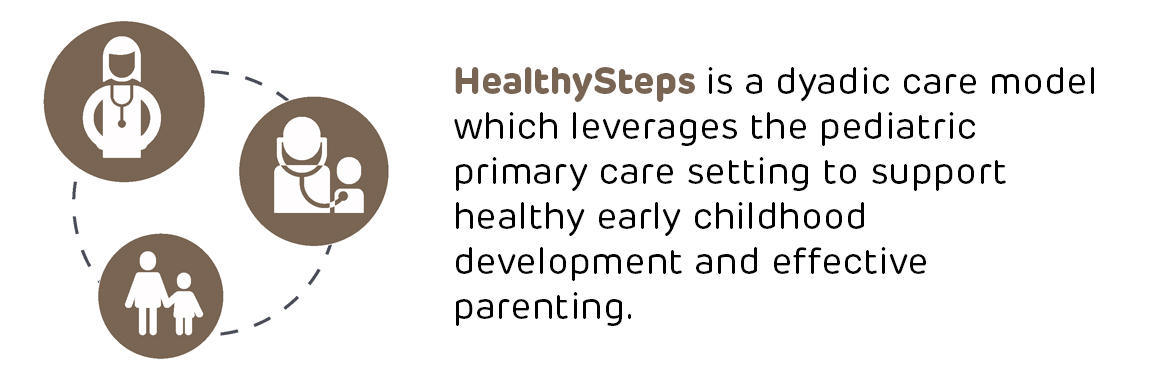
While there is evidence to support the implementation and scaling of family-oriented prevention services in early childhood and dyadic care models, this project will grow the evidence base for the HealthySteps model and include advocacy efforts specific to our local and state landscape to support program sustainability.
Over the past three years, a collaborative team—with members from PolicyLab, the Department of Child and Adolescent Psychiatry and Behavioral Sciences (DCAPBS) and the CHOP Care Network — led a pilot to implement and evaluate HealthySteps at Cobbs Creek Primary Care in West Philadelphia. Evaluations of HealthySteps to date have shown a wide range of key positive outcomes in child health, parenting knowledge and practices, family health and well-being, and with practices and providers. Our team led a hybrid implementation-evaluation design coupling strong quantitative and qualitative methodologies to understand the local context for successful implementation and outcomes related to provider and patient receptivity and satisfaction, child health and development, parenting knowledge and practices, and family health and well-being.
Building off these findings, we have leveraged policy and communication efforts and expertise to inform and advance reimbursement and payment innovation to support the delivery of dyadic, integrated, family-centered care within and beyond the primary care setting.
Piloting HealthySteps has brought much needed services and supports to the West Philadelphia community, and the ongoing evaluation is supporting a robust assessment of proof of concept, quality improvement and effectiveness. The project is also making the case for financing mechanisms to scale and sustain the model.
With the overarching goal of promoting equity in early childhood development among children in the West Philadelphia community, this pilot has supported early identification of unmet behavioral health needs, improved service accessibility and sustainability, and enhanced family support through pediatric primary care as a trusted community resource. Specifically, over the last three years, we:
- Applied implementation science methodology to pilot HealthySteps at Children’s Hospital of Philadelphia’s Cobbs Creek Primary Care site
- Used a hybrid evaluation design to assess implementation and generate an understanding of the local context impacting feasibility, acceptability, quality, and replicability of outcomes related to provider and patient receptivity engagement and satisfaction, child health and development, parenting knowledge and practices, and family health and well-being
- Engaged key national, state, and local stakeholders and policymakers to understand the opportunities and barriers to payment innovation, make the case for reform and, ultimately, identify sustainable funding pathways for HealthySteps in Pennsylvania
Next Steps
As we shift from the pilot phase of the project, we will:
- Explore opportunities to expand HealthySteps to other sites in the CHOP Care Network
- Solidify technology infrastructure innovations to support implementation
- Strengthen sustainability efforts by collaborating with stakeholders and policymakers to advance reimbursement reform that supports widespread, long-term adoption of dyadic care in pediatric settings
- Publish findings, recommendations, and best practices for broad dissemination among relevant stakeholders and publications
This project page was last updated in July 2026.
Suggested Citation
Children's Hospital of Philadelphia, PolicyLab. Piloting HealthySteps: Implementation, Evaluation and Exploration of Policy to Support Sustainability [Online]. Available at: http://www.policylab.chop.edu. [Accessed: plug in date accessed here].