How Health and Human Service Professionals Can Address Intimate Partner Violence While Supporting the Whole Family
How can family-serving professionals respond to intimate partner violence (IPV) in ways that support survivors’ safety and healing—while also protecting children and strengthening the broader caregiving system around them? What does it mean to take a family-centered approach to IPV? How do we do that safely? And what can we learn from each other, as leaders across diverse organizations and systems that are testing new ways of working with families—and with each other—to meet the needs of all family members?
In June 2026, PolicyLab, the City of Philadelphia’s Office of Domestic Violence Strategies (ODVS), and the Philadelphia Department of Public Health’s Division of Reproductive, Adolescent and Child Health (ReACH) brought together leaders from family-serving systems and community-based organizations to consider these questions. At our one-day convening, advocates and professionals from across the U.S. gathered at PolicyLab to learn from the many programs trying new approaches to address IPV.
Below, speakers from the day share key takeaways they offered to participants and what gives them hope for the future of this work.
Editor’s Note: Responses have been edited for length and clarity.
CULTURALLY RESPONSIVE APPROACHES

Ana Maria Rodriguez, MEd – Manager of Counseling & Prevention Services, Congreso de Latinos Unidos
What innovations from your program or organization did you share? What inspires you about your program’s approach to addressing IPV?
At Congreso, we approach intimate partner violence through a whole-family, trauma-informed and culturally responsive lens. We intentionally support children, youth, caregivers, and family relationships, recognizing that violence impacts the entire family system. What inspires me most is seeing how healing becomes possible when families feel seen, respected, and empowered within the context of their own culture, values and lived experiences.
What outcomes from your program do you want others to know about? What outcomes are you most proud of?
The outcome I'm most proud of isn't a number; it's seeing families begin to break intergenerational cycles of trauma. Beyond individual healing, we've seen caregivers strengthen their parenting, children develop healthier emotional regulation skills, and families improve communication and relationships. We've also seen participants become leaders within their own communities by sharing resources, encouraging others to seek support, helping reduce the stigma surrounding intimate partner violence and even establishing their own nonprofits to continue serving our communities.
What do you want professionals working with pregnant and parenting families to take away from your program model?
I hope professionals remember that supporting a survivor also means supporting the family around them. Children are often the invisible survivors of intimate partner violence, and parents are often doing the very best they can under incredibly complex circumstances. Taking a culturally-responsive, strengths-based approach means listening before assuming, recognizing each family's unique context, and partnering with them to build safety, resilience and long-term healing.
What gives you hope for the future of this work to develop systems that better serve families experiencing intimate partner violence?
What gives me hope is seeing more organizations recognize the importance of collaboration and whole-family approaches. No single system can meet every family's needs, but when health care providers, community organizations, schools, and domestic violence programs work together, families receive more coordinated and compassionate support. I also find hope in the resilience of the families we serve, whose strength and commitment to creating better futures for their children continues to inspire this work every day.
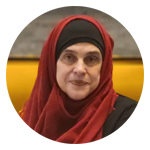
Denise Berte, PhD – Executive Director, Peaceful Families Project (PFP)
What innovations from your program or organization did you share? What inspires you about your program’s approach to addressing IPV?
The Peaceful Families Project conceptualizes prevention of family-based violence as a life-long opportunity. As such [it] provides culturally and faith-based programs for parents, youth, married individuals, Muslim men and boys, as well as those initiating divorce or co-parenting.
What outcomes from your program do you want others to know about? What outcomes are you most proud of?
The Peaceful Families Project is most excited about our work that utilizes faith-based traditions and beliefs and is embedded in religious communities. PFP's work has confirmed what we have long known, that the desire to live in congruence with your faith values is a strong motivator to change behaviors that put families at risk including violence.
The Peaceful Families Project is proud of our ability to engage men and boys of faith, especially religious leaders, in much needed conversation and dialogue to partner and collaborate together in addressing ways to prevent and intervene with family-based violence within their communities. Only in working together can we understand and create programs that will serve the entirety of the Muslim community.
INNOVATIVE PUBLIC SYSTEM APPROACHES

Cherita Reese-Butler – Executive Director of Multi-Therapy Services and Senior Director at WES Health Systems
What outcomes from your program do you want others to know about? What outcomes are you most proud of?
Since its inception in the fall of 2023, the WES Supervised Child Custody Visitation has served 354 families, including 470 children. My proudest outcome is that only 5.9% of families have been discharged and referred back to Family Court due to safety concerns or policy violations during this timeframe. This outcome reflects the strength of our program model, which is composed of behavioral health and school-based professionals with behavioral health education and experience who understand the complexities of IPV, trauma and family dynamics. Their ability to de-escalate conflict, respond to intense emotional reactions with empathy and clinical insight, while maintaining a trauma-informed approach has been instrumental in supporting families to ensure safety remains priority. This outcome demonstrates that when behavioral health expertise is integrated into supervised visitation services, families can be better supported through challenging circumstances while maintaining safety.
What gives you hope for the future of this work to develop systems that better serve families experiencing intimate partner violence?
What gives me hope for the future is the growing recognition that safety and family connection can coexist when systems are intentionally designed to meet the unique needs of families experiencing IPV.

Holland Dvorack – Housing Initiatives Coordinator, End Domestic Abuse WI
What innovations from your program or organization did you share? What inspires you about your program’s approach to addressing IPV?
To experience domestic violence is to experience housing insecurity. That’s why the Domestic Violence Housing First (DVHF) pilot is so important. We all experience crises – a flat tire, illness, loss of income – these experiences are common. However, if someone does not have access to money due to financial abuse or experiencing poverty, a flat tire, a sick child, or loss of income can lead us closer to homelessness [which is what DVHF aims to address]. Advocates can alleviate this pressure by addressing the initial crisis: your car breaks down – we got you. You need to miss work to care for a sick child – we can pay for child care so you can continue to work. We are not required to check to see if traditional funding sources allow for this or that – we have the flexibility and agency to just make it happen.
What outcomes from your program do you want others to know about? What outcomes are you most proud of?
The DVHF pilot increased staff morale and retention rates. Advocates make this work move – they receive you on your worst day, hold you with kindness and safety. In this work we lose advocates, not because of the vicarious trauma, or the multiple hats we wear. We lose them because the expectation is to do all of that without benefits, equitable wages and because restrictive funding only gives us a small percentage of what we need to address the complex experiences of survivors. DVHF gave programs a funding source that allowed flexibility in staff salary, that allowed advocates to say “yes” without the time-consuming and burdensome requirements to obtain grant modifications. High turn-over rates in DV programs lead to survivors re-telling their stories, gaps in service and interruption in community partner relations. The DVHF pilot gave the gift of time for more meaningful and stable advocacy supports.
DVHF recipients reported a decline in the number of places they slept, changes in housing, number of housing applications submitted and experiences of discrimination when seeking housing. The Domestic Violence Housing First pilot did not solve the housing crisis, unfortunately. There were still concerns with high rental and utilities costs, and challenges with landlords.
We saw an increase in school attendance among the children impacted by DVHF. If we continue to use the DVHF model we have the opportunity to prevent future generational harm. We know that access to meaningful education increases stability. Kids can make friends, connect with safe teachers, create bonds and form a sense of identity outside of the home.
What gives you hope for the future of this work to develop systems that better serve families experiencing intimate partner violence?
The DVHF model has created a moment of stability for survivors. Flexible financial assistance has been liberatory for survivors and advocates. Additionally, it opens space for trust among funders and programs. Fluidity and flexibility are so important. Our lives are not static and our experiences are not linear. Our approach to advocacy should meet the complexities of survivors’ experiences – each story is unique to them and their lived experience.
Survivors know what they need to thrive. Empowering advocates to support those dreams prevents further exposure to violence.

Meredith Matone, DrPH, MHS – Co-lead on IPV-Home Visiting Collaborative project, Director, PolicyLab
Editor's Note: The following reflections are shared by Meredith Matone on behalf of the IPV-Home Visiting Collaborative. The Collaborative's work is informed by its many partners, including conference panelist Adrianne Edwards, an IPV-HV Resource Specialist whose leadership helped shape the discussion at the conference.
What innovations from your program or organization did you share? What inspires you about your program’s approach to addressing IPV?
I shared about our team’s co-creation of the Intimate Partner Violence-Home Visiting (IPV-HV) Specialist model, a unique approach that builds the skills and capacity of home visiting professionals to serve as IPV resource specialists. Specialists become part of our larger IPV-HV Collaborative, where they receive ongoing learning, peer support and opportunities to share their expertise with others. What inspires me most is the model’s flexibility and focus on collaboration; it allows each organization to tailor the work in ways that meet their needs. I’m especially proud of the deep connections we’ve created between home visiting and IPV organizations and also city structures like Shared Safety.
What outcomes from your program do you want others to know about? What outcomes are you most proud of?
I’m particularly proud of the trainings and community events led by our IPV-HV Specialists and partners at Lutheran Settlement House and Courdea. We heard such an enthusiastic response from the home visiting community, who appreciated hearing firsthand from fellow home visiting professionals about how they integrate survivor-centered, trauma-informed methods in their work with families and young children.
What gives you hope for the future of this work to develop systems that better serve families experiencing intimate partner violence?
What gives me hope is seeing so many people come together with a shared commitment. The room was filled with solutions-oriented advocates, practitioners and innovators who are eager to collaborate. That kind of collective energy is powerful.
HEALTH SYSTEM APPROACHES

Aasta Mehta, MD, MPP – Director, Division of Reproductive, Adolescent, and Child Health, Philadelphia Department of Public Health
What innovations from your program or organization did you share? What inspires you about your program’s approach to addressing IPV?
We built a citywide partnership between health care systems and domestic violence agencies to implement universal IPV screening during pregnancy and the postpartum period, pairing provider training with enhanced warm handoffs, an emergency assistance fund that provides concrete goods and a public awareness campaign connecting IPV to maternal mortality. What inspires me most is the recognition that preventing IPV-related maternal deaths requires systems working together—not health care or advocacy organizations acting alone.
What outcomes from your program do you want others to know about? What outcomes are you most proud of?
I am most proud that all birthing hospitals in Philadelphia are now implementing universal IPV screening with stronger relationships between hospitals and community-based services. Just as importantly, we have helped shift the conversation by elevating IPV as a critical driver of maternal mortality and a public health issue that demands a coordinated response.
What gives you hope for the future of this work to develop systems that better serve families experiencing intimate partner violence?
I am hopeful that we have built the partnerships and infrastructure to make universal screening sustainable while continuing to strengthen the systems that connect families to meaningful support when they need it most. The future of this work lies in ensuring health care, public health, and community organizations function as one coordinated system rather than a collection of separate programs.