
School Adolescent Mood Project: Examining the Effects of an Evidence-based Depression Prevention Program in Schools
Statement of Problem
Adolescent depression has become a major public health concern as it grows in prevalence and we learn more about its associated adverse outcomes, such as suicide, educational underachievement and mental health issues later in life. Therefore, there is a critical need for the development and implementation of depression prevention programs, particularly in schools where youth are most likely to receive mental health services. School-based programs have the potential to prevent depression, promote healthy development and maximize school success.
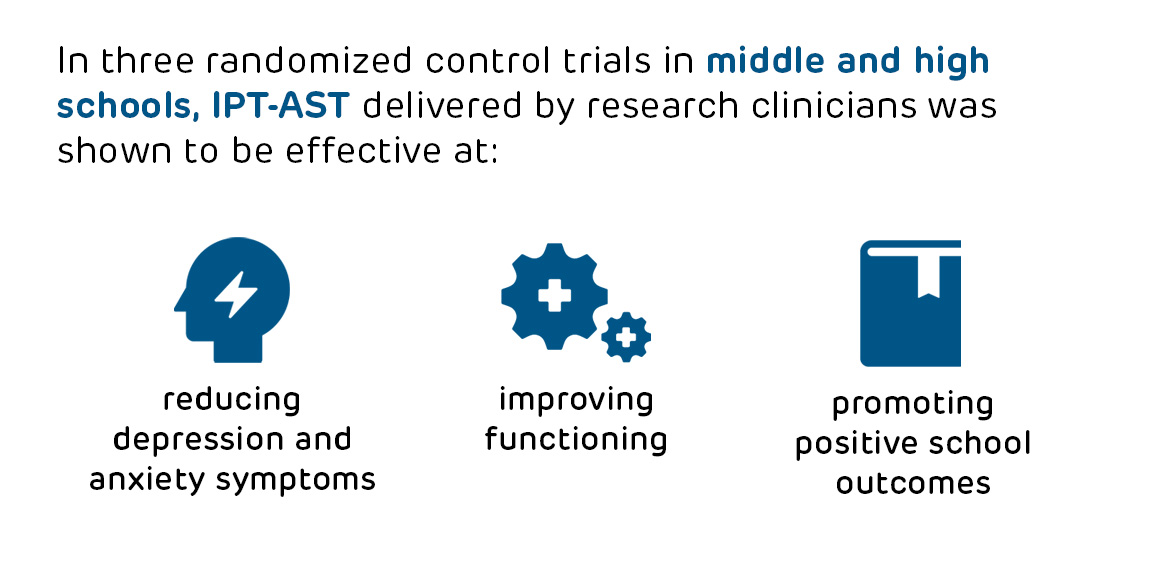
One such program is Interpersonal Psychotherapy-Adolescent Skills Training (IPT-AST), a prevention intervention that teaches students communication and interpersonal problem-solving strategies to decrease conflict, increase support, and improve social functioning, vulnerability and protective factors for depression. Importantly, IPT-AST has proven to be highly acceptable among students, and has demonstrated robust effects. In three randomized controlled trials in middle and high schools, IPT-AST delivered by research clinicians was shown to be effective at reducing depression and anxiety symptoms, improving functioning, and promoting positive school outcomes, more so than usual school counseling and counselor-led groups that matched IPT-AST in frequency and length of sessions. Based on this research, IPT-AST has been classified as a promising Blueprints program.
Mental health care delivery has changed quickly and dramatically as a result of COVID-19, with the majority of services being delivered remotely through digital health. As we begin to think about school-based services in the coming years, we have an opportunity to apply lessons learned from recent growth and innovation in digital health and to study the acceptability and efficacy of school-based mental health interventions, such as IPT-AST, when delivered through telehealth.
Description
School Adolescent Mood Project: Examining the Effects of an Evidence-based Depression Prevention Program in Schools
School Adolescent Mood Project: Examining the Effects of an Evidence-based Depression Prevention Program in Schools

Interpersonal Psychotherapy-Adolescent Skills Training teaches students communication and interpersonal problem-solving strategies to decrease conflict, increase support, and improve social functioning, vulnerability and protective factors for depression.
The purpose of our study is to test whether IPT-AST is effective when delivered through telehealth in local schools. We will randomly assign adolescents with elevated symptoms of depression to IPT-AST or services as usual (SAU). IPT-AST will be delivered through telehealth by research staff (alone or in collaboration with school support staff) and SAU will be delivered by counselors or other student support staff in schools. The study will measure social outcomes, emotional outcomes, and school outcomes among adolescents. It will also assess acceptability, feasibility, fidelity, and sustainability of the program, as well as costs and cost-effectiveness. This study will provide vital information on telehealth-delivered IPT-AST and will promote the provision of more effective care in schools.
Next Steps
Our ultimate goal is to enable the dissemination of IPT-AST and other prevention programs in schools to promote positive social, emotional and school functioning for all youth. IPT-AST shows great potential as a depression prevention program. However, the promise of IPT-AST cannot be fully reached until we demonstrate that IPT-AST results in positive and sustained effects on emotional and school outcomes compared to SAU.
This project page was last updated in April 2021.
The research reported here is supported by the Institute of Education Sciences, U.S. Department of Education, through Grant R305A190088 to Dr. Jami Young.
Suggested Citation
Children's Hospital of Philadelphia, PolicyLab. School Adolescent Mood Project: Examining the Effects of an Evidence-based Depression Prevention Program in Schools [Online]. Available at: http://www.policylab.chop.edu [Accessed: plug in date accessed here].